
ALTON, ILLINOIS | PROPOSED
From steel mill to data center.
TerraWatt proposes to redevelop the former Alton Steel mill on Cut Street as the Riverbend Technology Center, a grid-powered data center. It would put the 381-acre site back to work, pay for its own cleanup, and ask for no local tax incentives.
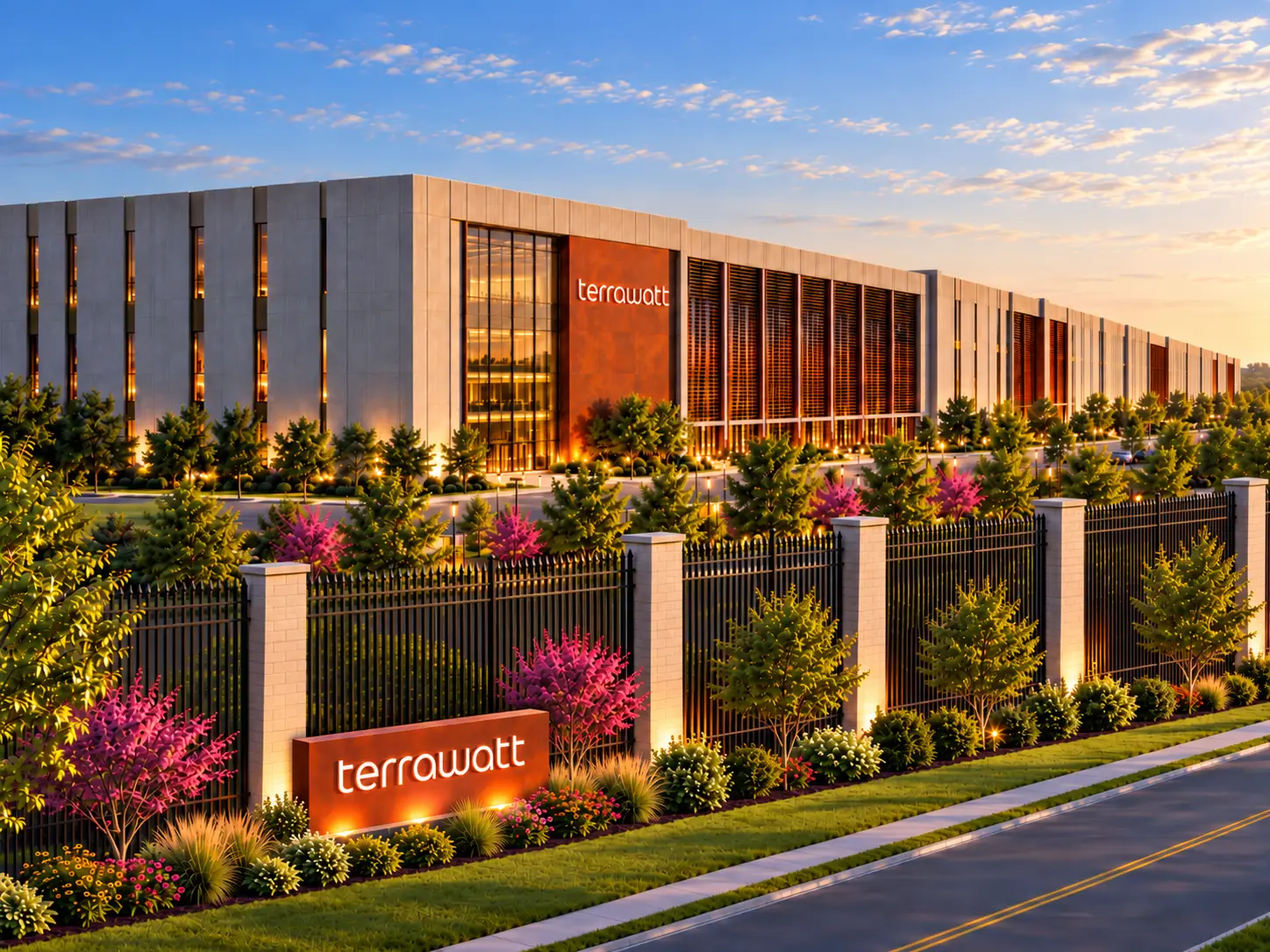
Conceptual rendering. Final design is subject to City of Alton review and community input.
Putting the mill site back to work.
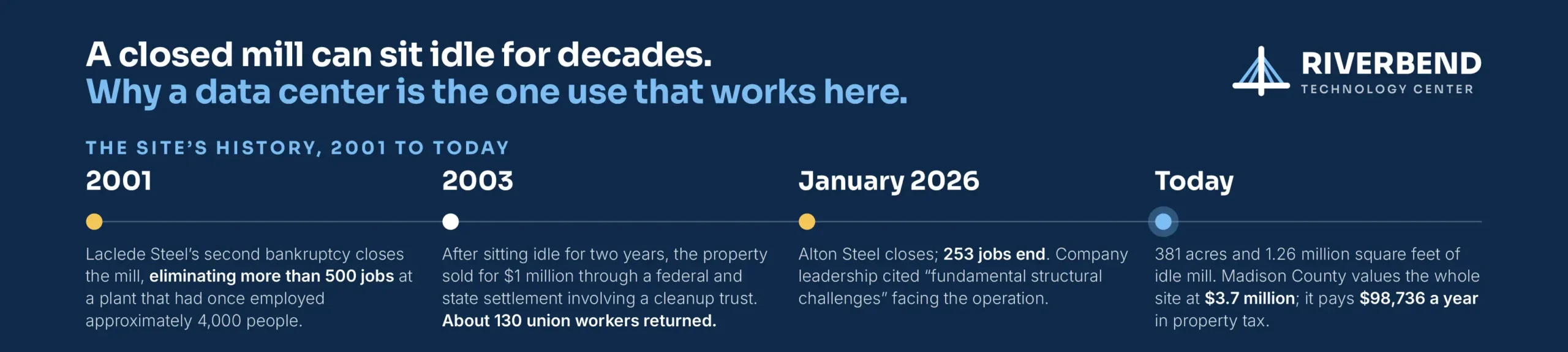
Steel was made at Cut Street for more than a century. The last mill closed in January 2026. TerraWatt would clear the mill buildings, pay for the cleanup, and build a data center in their place: a secure building full of computer servers that runs the services people use every day, from email to banking to health records.
We believe in responsible development, and we want to hear from the people of Alton before plans are settled.

Grid-powered
Power comes from the Ameren Illinois grid through a new connection TerraWatt pays for.
Not a power plant
No smokestack, no manufacturing, and no natural gas burned on site.
Built in blocks
One 200 MW block first. Up to five (1 GW) only as Ameren confirms it can serve them.
381 Acres
Former Alton Steel mill site, idle since January 2026
200 MW
First block, built in phases as Ameren confirms service
$17.2 Million
Projected property tax in the first full year, against $98,736 today
$0
Local tax incentives requested
Quieter than anything that has stood here in a century.
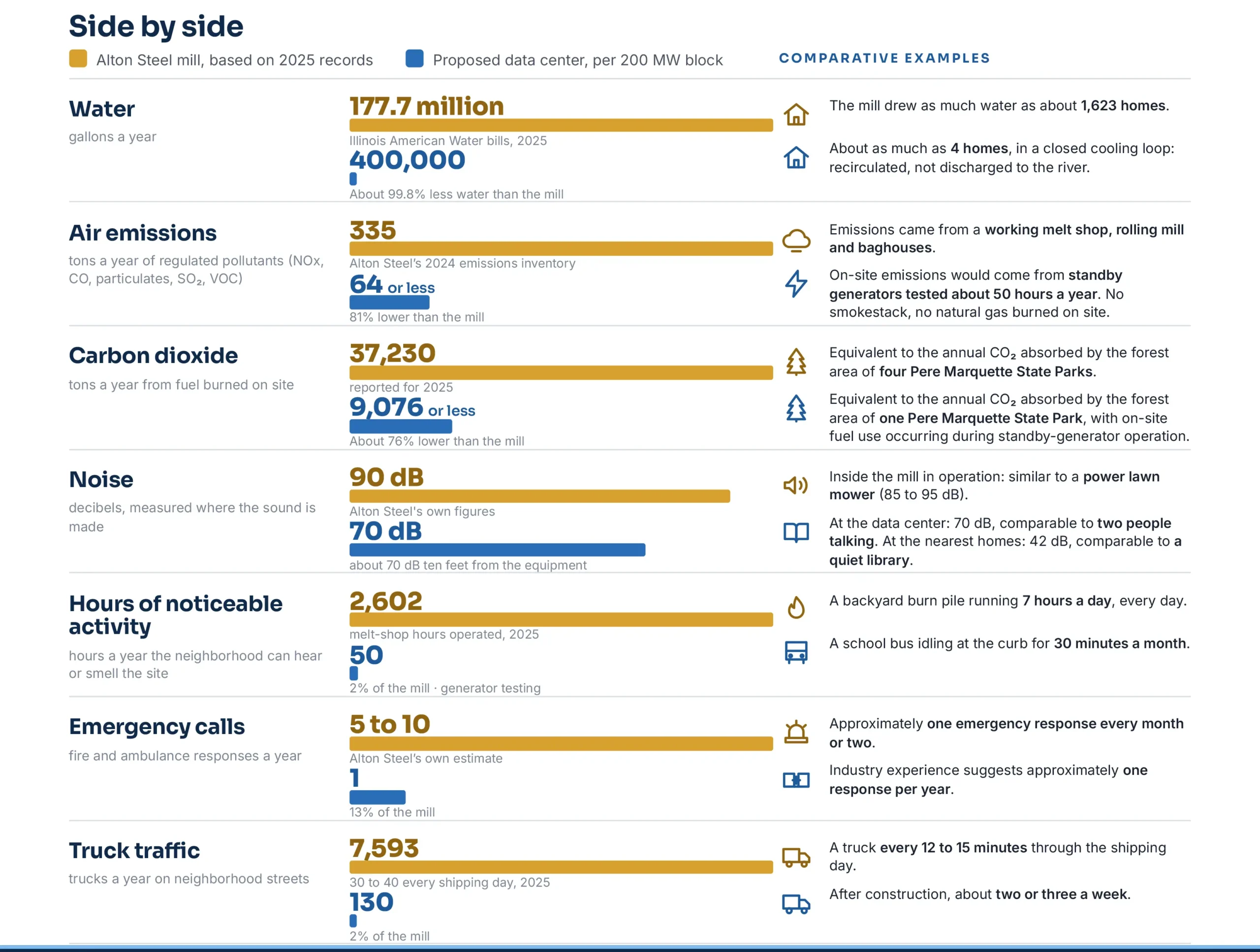
Here is how one 200 MW data center block compares with the steel mill on the things neighbors experience most: water, air, noise, activity, emergency calls and trucks.
- 99.8% less water: About what four homes use, in a closed cooling loop
- 42 dB at the nearest homes: About the level of a quiet library
- 98% fewer trucks: Two or three a week after construction, down from 30 to 40 a day
New revenue for schools and city services.
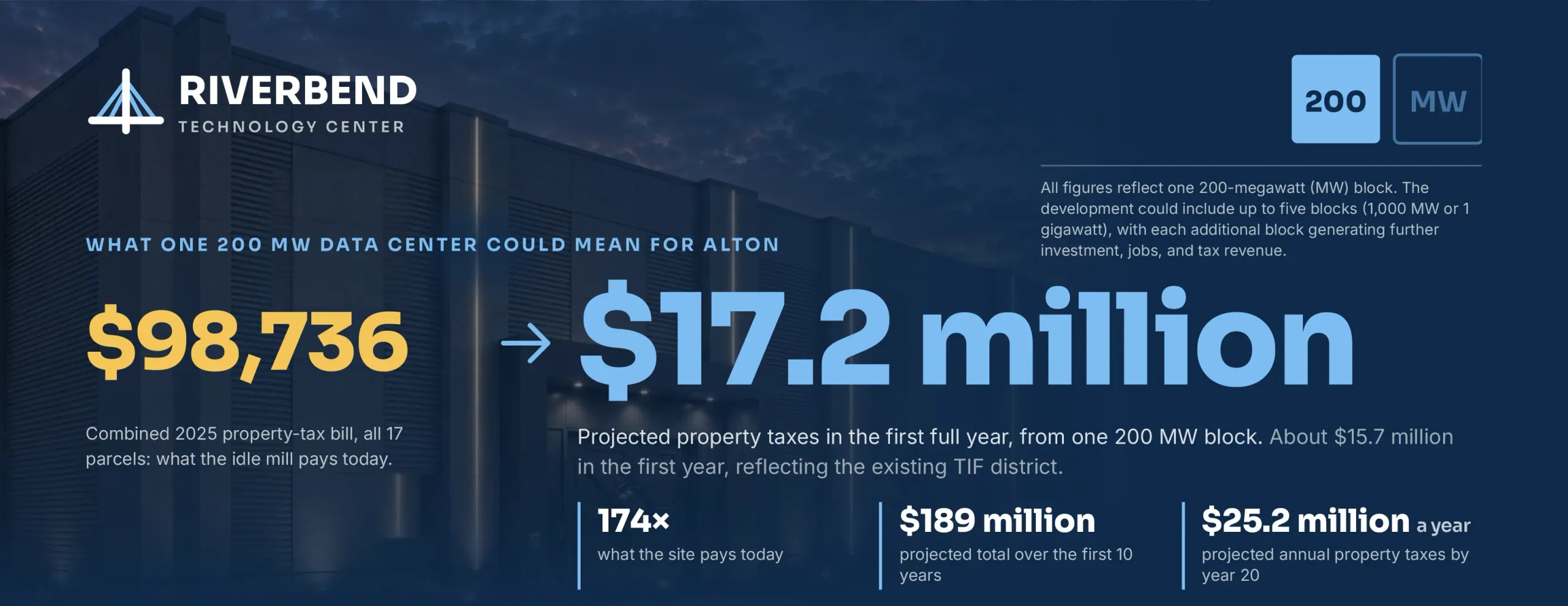
The idle mill pays $98,736 a year in property tax. One 200 MW block is projected to pay far more, with most of it going to Alton School District 11. How the revenue is used is decided by the community’s taxing bodies.
- +$9.9 million a year: For Alton School District 11, a 19% increase on its 2025 levy
- +$4.2 million a year: For the City of Alton, a 48% increase on its 2025 levy
- $2.64 billion: Investment per block, with 50 permanent jobs averaging $90,000 or more
COMMUNITY OPEN HOUSE
Tuesday, Oct 27, 6 to 7:30 p.m.
The Wedge, 620 E. Broadway, Alton. Meet the project team, ask questions, and tell us what matters to you about landscaping, screening, and how the site fits the neighborhood.
HAVE YOUR SAY
Tell us what matters to you.
Share your views on landscaping and screening, construction traffic, local hiring, and anything else on your mind. The survey takes about 5 minutes.
Your questions, answered.
Every community is unique, and so is TerraWatt’s approach to every project. The Riverbend Technology Center proposal would put the dormant mill site on Cut Street back to work, helping Alton build its economy for the next century and generating significant new tax revenue for the city and its schools, while asking for no local tax incentives. We believe in responsible development. We will be a good neighbor, quieter than anything that has stood on this site in a hundred years. We look forward to hearing from the people of Alton, learning what matters most to them, and shaping the right project for this community.
The project
The Riverbend Technology Center, a data center built on the mill site after the mill buildings come down. A data center is a secure building full of computer servers, with the electrical and cooling systems that keep them running. It would be powered from the Ameren Illinois grid. There would be no manufacturing, no smokestack and no power plant. The first phase is one 200-megawatt block, planned for the parcels where the furnaces and rolling mills stand today.
Essentially, what’s being proposed is one of the buildings that makes your phone, tablet, and computer work. Email, banking, video, health records: all of it lives on servers someplace, and this would be one of those places.
It runs the services people use every day: email, cloud storage, video, online banking, health records, payroll. Nothing is made there, and nothing leaves except data over fiber lines. From the outside it looks like an industrial building inside a landscaped fence. The St. Louis region has had data centers for decades, and most people have never noticed them.
No. The site would draw its power from the Ameren Illinois grid through a new connection that TerraWatt pays for. “200 megawatts” describes how much power the building would use, not anything it would make. The only engines on the property would be backup generators, which would run for testing a few hours per month or during a utility outage, similar to a hospital.
The project would be built in 200-megawatt blocks, and every number in these pages describes one block. More blocks, up to a maximum of five or 1-gigawatt total, would be added only as Ameren confirms it can serve them.
They come down. About 1.26 million square feet of mill, plus the scrap and slag piles, would be cleared before anything new is built, with asbestos and other regulated materials removed under Illinois EPA and OSHA rules. TerraWatt pays for all of it, and no public money is involved.
What Alton gets
No. TerraWatt is not asking for any local tax incentives. While the site is located within the Riverfront TIF district, which expires in December 2029, TerraWatt will not use or request funds captured by the district to benefit the project. We hope those funds can benefit the objectives established by the TIF. The project does use one State of Illinois program that is open to any qualifying data center: it exempts the computer equipment and building materials from sales tax, and in return the State requires at least $250 million of investment, new full-time jobs, union construction labor, carbon-neutral operation, a commitment to twenty years in Alton, and an annual report to the State. The exemption is renewed only if the project keeps those commitments, and if the project quit within its first twenty years the State could take back some or all of the taxes it exempted.
Property tax, mostly. The whole site paid $98,736 in property tax last year. One 200-megawatt block would pay an average of $17.2 million a year at today’s tax rates over its first ten years, with significant value the first full year after it is built. [Flag 2: conflicts with placemat] The first few years are lower than that average because the site sits in the Riverfront TIF district until it expires in December 2029. Most of the property tax goes to Alton School District 11, with the rest to the City, Lewis and Clark Community College, Madison County, the Hayner Library District, the township and the airport authority. The City would also receive about $544,000 a year in municipal electricity tax, up from about $49,000 average received from the mill.
The City of Alton, like many communities across the country, is faced with rising insurance and infrastructure costs that put pressure on its ability to maintain essential services. The proposed data center would generate new annual tax revenue to help meet those costs, improve infrastructure and ease pressure on local taxpayers.
At least 50 permanent, full-time jobs for each block once it is running, at an average wage above $90,000: technicians, electricians, HVAC and mechanical trades, network and security staff, logistics and facility management. Building it would take about 4,500 [Flag 1: placemat says 4,846] construction jobs under a project labor agreement, which means union labor from the regional building trades. TerraWatt is working out plans for local hiring and training.
It is a different kind of employer, and it is fair to say so. A data center employs fewer people than a steel mill, pays them well, and pays far more in taxes: about $17.2 million a year against $98,736. It also takes about two years of construction work to build each block. Nothing replaces what the mill meant to the families who worked there. What this project can do is put the site back to use, pay for its own cleanup, and contribute substantially to city services and schools.
Power, water, noise and traffic
Not because of this project’s connection to the grid. The Riverbend Technology Center pays for the substation, lines and equipment built to serve it. That is how Ameren Illinois’ ICC-approved rules for large customers work, and Ameren has told state lawmakers it requires large customers to pay for the infrastructure they need. The project also pays Ameren delivery charges every month, which helps cover the cost of the grid everyone already uses.
Neither TerraWatt nor the project sets anyone’s rates. Ameren’s delivery charges are set by the Illinois Commerce Commission, and the price of the electricity itself comes from the regional market. The project buys its own power under separate contracts and does not draw on the supply purchased for households.
No. The Riverbend Technology Center would connect to the high-voltage transmission system through its own new connection, not the neighborhood lines that serve homes and businesses. Ameren studies what its system can serve before it connects anything, and it won’t connect a load its system can’t carry. A steady load like this is easier for the grid to plan around than the mill’s furnaces, which surged every time they fired.
About 400,000 gallons per year, roughly what four homes use, and 0.2% of what the mill used. The cooling system would be a sealed loop: filled once and topped up occasionally, with no water evaporated and nothing discharged to the river. The mill drew about 178 million gallons a year, according to its own water bills. The Riverbend Technology Center would connect to Illinois American Water like any customer and pay for its own connection.
Not much, if at all. The cooling equipment would run at about 70 decibels right next to it, about the level of two people talking, and the sound drops with distance. At the nearest homes, over 250 feet away and across the Union Pacific rail line, it would be no higher than 42 decibels, the level of a library. The Riverbend Technology Center would have to meet Illinois’ residential noise limits at the nearest homes, and the equipment would be placed and shielded to do that. Backup generators are louder while they are being tested, which is why tests would be scheduled for weekday daytime hours.
The generators would be diesel units that meet the strictest federal emission standard for this equipment, known as Tier 4 Final. They would run about 50 hours total per year each, for testing and during outages, and the Illinois EPA permit would cap those hours. Even in a worst-case year that is about a fifth of what the mill’s furnaces and stacks put out, with no smokestack and no natural gas burned on site.
After construction, truck traffic would drop by approximately 98% compared with the steel mill, from about 7,600 trucks annually to roughly 130, or two to three a week. That means substantially fewer heavy trucks on local streets and less truck-related wear on City roads.
Construction would temporarily increase traffic for about two years. TerraWatt’s contractor will submit a traffic plan to the City that routes trucks along East Broadway and Cut Street, keeps them off residential streets, and avoids school and commuter peak times.
A long, low building inside a landscaped fence, where the mill buildings stand today. The mill structures are the tallest things on the site, and they come down. Lighting would face downward and be no brighter than security requires. TerraWatt wants to hear from neighbors about landscaping and screening before those plans are settled, and our October 27 open house is the first chance to weigh in.
Approvals and timing
The City of Alton. The data center would require a use determination and approval of rezoning to the M4 planned district, including review and public hearings at the Plan Commission and City Council. Ameren Illinois has to confirm it can serve the site, and Illinois EPA issues the air permit for the generators and the construction stormwater permit.
If the approvals come through, demolition and site work would begin in 2027, construction of the first block would run from late 2027 into early 2029, and the Riverbend Technology Center could be fully operating by 2031. Property taxes on the new building start with the first full year after it is built.
Come to the community open house on Tuesday, October 27, from 6 to 7:30 p.m., at The Wedge, 620 E. Broadway, Alton, IL 62002, or contact Steadfast City at developbetter@steadfastcity.com. The public hearings are the formal place for comments, and the City notices them. TerraWatt plans to publish this document at terrawatt.com/riverbend and update it as the design is finalized and as the project goes through the process.
A single large tenant would lease a block, install its computers and run its operations there. TerraWatt is in discussions and hasn’t signed any lease. Tenants in this industry require confidentiality until a lease is signed, and sometimes until the building opens, for competitive and security reasons. The tenant’s name would be announced when the lease allows. Either way, the jobs and investment are reported to the State every year.
What’s in writing
Until the sale closes, the property stays Alton Steel’s. After that, the owner would be responsible for the site, including the environmental obligations that are recorded against the land and follow it to any future owner. The State certificate requires twenty years of operation, and if the project quit within its first twenty years the State could take back some or all of the taxes it exempted. A data center is a conventional single-story building on cleared ground, far easier to reuse or remove than a steel mill.
Because the commitments are in writing with the State, the City and Illinois EPA, and each one has consequences. The State certificate sets the jobs, investment, union labor, carbon-neutral operation, twenty years of operation and annual reporting, with the exemption at risk if they are missed. The City’s land-use approvals and Illinois EPA’s permits set their own requirements, including the cap on generator hours. TerraWatt also plans to publish this document and update it as the design is finalized, so people can check what was said against what gets built.
Questions or concerns?
Contact the project’s community team at developbetter@steadfastcity.com. Public hearings at the Plan Commission and City Council are the formal place for comments, and the City will notice those dates. This page will be updated as the project moves through the City’s process.
Last updated October 21, 2026. Projections are estimates, not guarantees. Sources for all figures appear on the community impact summary.

